

 de
de it
it ja
ja zh
zhTool Selection and Cutting Parameter Optimization for High-Speed Milling of Titanium Alloys
Key Technologies for Solving Titanium Alloy Machining Challenges
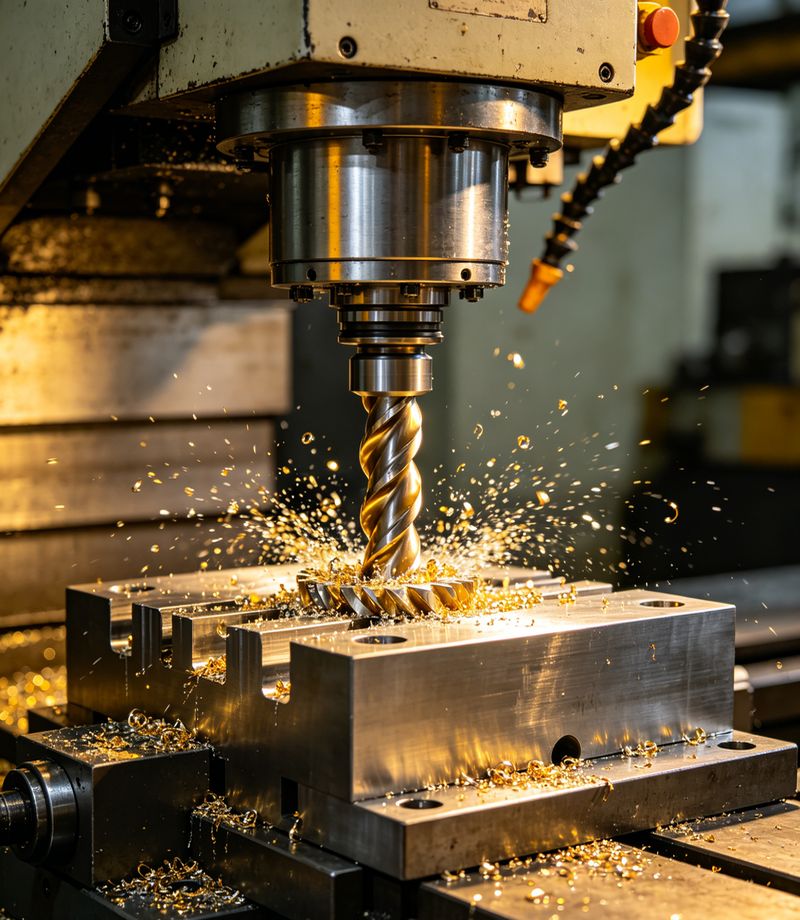
Titanium alloys are widely used in aerospace, medical devices, and other fields due to their excellent specific strength and corrosion resistance. However, their low thermal conductivity and high chemical activity also pose significant challenges to machining. This article systematically introduces tool selection and parameter optimization methods for high-speed milling of titanium alloys.
I. Analysis of Titanium Alloy Machining Difficulties
The machining difficulties of titanium alloys (taking TC4 as an example) are mainly reflected in the following aspects:
Poor thermal conductivity: Heat concentrates in the cutting zone, causing rapid tool temperature rise
High chemical activity: Prone to chemical reactions with tool materials at high temperatures
Low elastic modulus: Prone to vibration and deformation during machining
Severe work hardening: Surface hardness can increase by 200%-300%
II. Tool Material Selection
Based on the characteristics of titanium alloys, the following types of tool materials are recommended:
Tool Type | Application Scenario | Advantages |
|---|---|---|
Cemented carbide (fine-grained) | Roughing/semi-finishing | High cost-effectiveness, good impact resistance |
Solid carbide | Finishing/hole machining | Good rigidity, high precision |
PCD/CBN | Ultra-precision machining | Excellent wear resistance |
III. Cutting Parameter Optimization Practice
Based on extensive experimental data, we have summarized the following optimized cutting parameter ranges:
Roughing stage:
Cutting speed: Vc=30-50 m/min
Feed per tooth: fz=0.08-0.15 mm/z
Axial depth of cut: ap=1-3 mm
Radial width of cut: ae=0.5-1.5×D
Finishing stage:
Cutting speed: Vc=50-80 m/min
Feed per tooth: fz=0.03-0.08 mm/z
Axial depth of cut: ap=0.2-0.5 mm
Radial width of cut: ae=0.1-0.3×D
IV. Cooling and Lubrication Strategy
Cooling and lubrication must be emphasized in titanium alloy machining. It is recommended to use high-pressure internal cooling (pressure ≥70 bar) combined with minimum quantity lubrication (MQL), which can effectively reduce cutting temperature while minimizing environmental pollution.